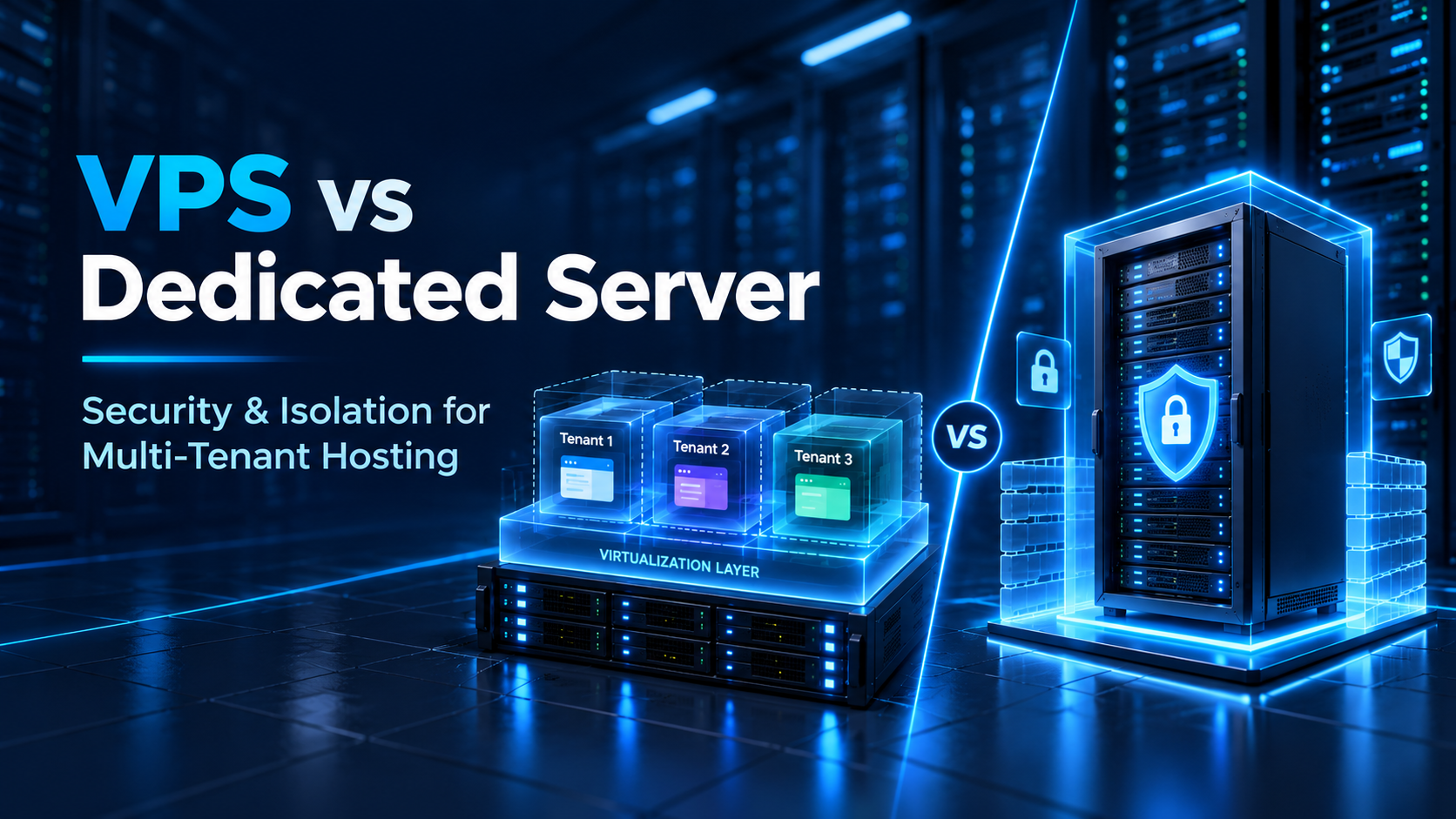
Managing hosting for multiple agency clients presents an architectural trade-off between operating costs and risk containment. When hosting multiple client websites, an agency's core technical priority is strict boundary isolation. A single compromised plugin or sudden traffic spike on one site must never compromise neighboring client properties on the same machine.
Agencies commonly choose between a Virtual Private Server (VPS) or a dedicated bare-metal server. While both support multi-tenant workloads, they handle hardware isolation, resource contention, and blast radiuses differently. Deciding between them requires understanding where physical isolation ends and operating system segmentation begins.
Direct Architecture Takeaways for Digital Agencies
- Hardware vs. Internal Isolation: A dedicated server removes public noisy neighbors and shared hypervisors, but client-to-client separation still requires OS-level permissions, containers, or virtualization.
- Failure Blast Radius: Stacking dozens of client sites on a single monolithic server concentrates risk. If that machine crashes, all hosted clients go down together.
- Compliance Reality: Dedicated servers do not generate automated regulatory compliance. Frameworks like HIPAA and PCI DSS require an end-to-end control suite across encryption, access, logging, and audits.
The Real-Estate Analogy: Commercial Floor vs. Private Office Building
To visualize the operational boundary between VPS and dedicated hosting, consider commercial office real estate:
Deploying a VPS is like leasing a secured floor inside a corporate office tower. You have a private keycard, and other tenants cannot enter your floor. However, you still share the building's central elevators, water lines, and electrical grid. If the tower's infrastructure undergoes maintenance, your leased floor is impacted.
Deploying a Dedicated Server is like buying an entire standalone building. You control perimeter gates and own 100% of the utilities—no external tenant shares your property. However, inside the building, you cannot leave internal rooms open. You must still install locked doors and access control badges to keep individual client suites private.
Security and Isolation Realities: Evaluating the Trade-Offs

Figure 1: Boundary isolation and container compartmentalization safeguarding multi-tenant client sites.
1. Cross-Site Contamination and OS-Level Sandboxing
A common misconception is that dedicated hardware automatically prevents cross-site infection. Hardware does not parse application code. If an agency hosts multiple sites under a single web user without sandboxing, a compromised PHP script on one site can inspect directories, databases, and config files across all neighboring accounts.
Achieving true client-to-client isolation on either VPS or dedicated hardware requires deliberate OS-level mechanisms. Tools like CloudLinux with CageFS, Docker containers, systemd namespaces, or dedicated unprivileged Linux users jail each account in its own virtual root filesystem. These guardrails stop lateral malware traversal when an individual website suffers an exploit.
2. Resource Contention and Variable Sizing Realities
Server capacity cannot be calculated using static site counts like "16 GB RAM holds 30 websites." Real capacity depends on CPU cycles, concurrent PHP-FPM workers, database query volume, Redis cache hits, background cron jobs, and plugins. An illustrative example: a single busy WooCommerce store can saturate 16 GB of RAM, whereas thirty cached brochure sites might use under 3 GB.
When running multiple tenants on a VPS, resource limits set via cgroups prevent a single noisy tenant from monopolizing server memory. On a dedicated server, agencies gain deeper hardware buffers and NVMe throughput, allowing heavier workloads to process without hitting CPU throttles.
Technical context: Review how teams evaluate VPS vs dedicated server infrastructure when scaling production web applications.
3. IP Reputation and Email Deliverability Architecture
If one hosted tenant's contact form is compromised by spambots, mail-filtering systems blacklist the server's outbound IP address. While binding individual dedicated IP addresses to client accounts helps separate network reputation, IP allocation alone does not resolve deliverability.
Deliverability depends on DNS records (SPF, DKIM, DMARC), reverse DNS (PTR), and clean IP reputation. For multi-tenant agencies, best practice decouples outbound email entirely from hosting, routing client transactional mail through specialized relays like Postmark or SendGrid.
4. Regulatory Compliance Realities (HIPAA, PCI DSS, GDPR)
Hardware isolation is frequently linked to compliance, but dedicated servers alone do not guarantee compliant environments. Frameworks like HIPAA, PCI DSS, and GDPR assess an organization's complete administrative and technical control set.
While dedicated hardware simplifies audit scoping by eliminating shared hypervisors, full compliance requires data encryption at rest and in transit, strict access control, centralized logging, regular patching, vendor agreements (such as HIPAA BAAs), and independent audits.
Multi-Tenant Architecture Comparison Matrix
| Dimension | Multi-Tenant VPS Model | Dedicated Bare-Metal Model |
|---|---|---|
| Physical Isolation | Shared physical chassis; isolated by hypervisor. | 100% single-tenant hardware; zero external sharing. |
| Client-to-Client Isolation | Requires OS containers, CageFS, or separate users. | Still requires internal OS jails or internal VMs. |
| Resource Predictability | Virtual cores subject to hypervisor scheduling. | Full hardware consistency and exclusive NVMe bandwidth. |
| Failure Blast Radius | Limited to tenant partition; easy to split across VPSs. | Larger blast radius if all clients share one machine. |
| Scaling Flexibility | Instant vertical resizing of RAM and CPU in dashboard. | Requires manual hardware upgrades or cluster nodes. |
| Operational Complexity | Low to moderate; hypervisor maintenance handled. | Higher; hardware monitoring and RAID setup needed. |
| Security Responsibility | Shared model; host secures hypervisor and physical tier. | Agency manages OS kernel, firmware, and firewalls. |
| Cost Profile | Granular pay-as-you-grow pricing. | Higher fixed monthly base investment. |

Figure 2: Isolated multi-tenant server infrastructure segmented across partitioned application clusters.
What a Dedicated Server Does Not Automatically Fix
Deploying dedicated bare-metal hardware does not replace application-layer security hygiene. Physical infrastructure will not protect your agency from:
- Vulnerable Plugins and Themes: Unpatched software remains vulnerable regardless of underlying hardware.
- Weak File and Directory Permissions: Permissive 777 permissions allow cross-directory script execution.
- Reused Admin Passwords: Brute-force attacks succeed when clients use common credentials without MFA.
- Insecure PHP Configurations: Leaving execution functions like
exec()enabled invites shell execution. - Missing Off-Server Backups: Local hardware snapshots offer zero recovery if local disks get corrupted.
- Unmonitored Traffic: Without active log monitoring, malicious crawlers go undetected for weeks.
Recommended Multi-Tenant Agency Hosting Architecture
A production-ready agency deployment strategy separates client workloads based on business criticality and resource volatility:
Brochure and Standard CMS Sites
Consolidate lightweight corporate websites onto managed VPS nodes running CloudLinux or containerized accounts. Edge caching handles static delivery efficiently.
High-Traffic and WooCommerce Workloads
Isolate busy e-commerce stores onto independent VPS instances or dedicated machines. Dynamic cart queries require unconstrained PHP workers and NVMe IOPS.
Enterprise and Regulated Workloads
Deploy clients requiring strict compliance on dedicated bare metal. Combine physical isolation with automated off-site backups, Web Application Firewalls (WAF), and SIEM audit logging.
Frequently Asked Questions (FAQs)
Q1: Does a dedicated server automatically isolate hosted websites from each other? ▼
Q2: How should agencies calculate website capacity per server node? ▼
Q3: Does dedicated server hosting guarantee HIPAA or PCI compliance? ▼
Architectural Decision Framework: VPS vs. Dedicated Server
When engineering multi-tenant hosting environments, align server selections with workload profiles:
- Choose a VPS Model When: Managing early-stage client rosters, brochure websites, or applications requiring elastic scaling where operating budgets demand lean resource allocation.
- Choose a Dedicated Server Model When: Running massive database workloads, maintaining predictable sustained traffic, or servicing high-value enterprise accounts where shared hypervisor risks must be eliminated.
- Deploy a Hybrid Model When: Running an established agency. Host standard clients on partitioned VPS nodes while reserving dedicated machines for revenue-critical stores and compliance-bound accounts.

